

If you’re building or scaling a hiring process, you’ve likely run into two acronyms that get used almost interchangeably: ATS and CRM. They sound similar, they often live in the same tech stack, and vendors sometimes blur the line between them on purpose. But applicant tracking software and recruitment CRM solve two different problems – and knowing which one you actually need (or when you need both) can save you months of frustration and a lot of wasted budget.
This guide breaks down what each system does, where they overlap, and how to decide what fits your hiring goals.
What Is Applicant Tracking Software?
Applicant tracking software (ATS) is built to manage the mechanics of hiring for open roles. It’s transactional by nature a candidate applies, moves through a pipeline, and either gets hired or gets rejected. Along the way, the ATS handles job postings, resume parsing, interview scheduling, offer letters, and compliance documentation.
Think of an ATS as the operational backbone of recruiting. It answers questions like: Who applied for this role? What stage are they at? Who needs to leave feedback before we move to the next round? For high-volume hiring – retail, delivery, healthcare staffing, hourly workforces – a strong ATS is non-negotiable because it keeps hundreds or thousands of applicants organized without anyone falling through the cracks.
Common ATS features include:
- Job posting distribution across boards and career sites
- Resume parsing and keyword matching
- Structured pipelines and hiring stage tracking
- Interview scheduling and scorecards
- Offer management and e-signatures
- Compliance and EEOC reporting
What Is a Recruitment CRM?
A recruitment CRM (candidate relationship management system) takes a longer view. Instead of focusing only on people who’ve already applied, it’s built to manage relationships with candidates over time – including passive candidates who aren’t actively job hunting yet.
This is where talent acquisition software philosophy really shows up: recruiting isn’t just filling today’s requisition, it’s building a pipeline of relationships you can tap into for tomorrow’s roles. A recruitment CRM lets you segment talent pools, run nurture campaigns, track engagement, and re-engage silver-medalist candidates from past searches instead of starting from zero every time a role opens.
Common recruitment CRM features include:
- Talent pool segmentation and tagging
- Automated nurture sequences (email/SMS)
- Sourcing and passive candidate tracking
- Engagement analytics (opens, clicks, responses)
- Relationship history across multiple roles
- Employer branding and marketing-style outreach
The Core Difference
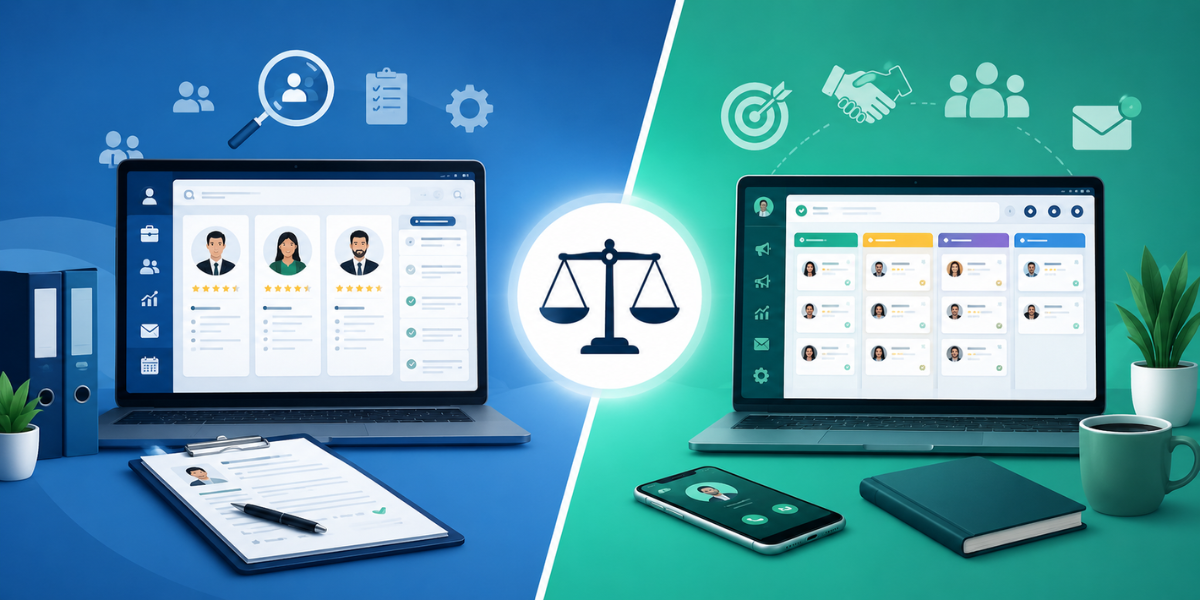
The simplest way to frame it: an ATS manages a process, a recruitment CRM manages a relationship.
An ATS is reactive – it starts working once someone applies. A recruitment CRM is proactive – it starts working before someone even knows they’re a candidate. One is about moving people through a funnel efficiently; the other is about keeping a warm bench of talent so your funnel never runs dry.
Volume matters here too. If you’re hiring at scale – think gig economy, last-mile delivery, warehouse, or seasonal staffing – the ATS side of this equation does the heavy lifting of screening and moving candidates fast. But without a CRM layer, you’re constantly starting from scratch, buying ads and posting jobs every time you need bodies, instead of drawing from a pool of people who already know your brand.
Where They Overlap (and Why the Confusion Exists)
Modern hiring platforms increasingly bundle both functions, which is exactly why the line gets blurry. Many vendors now market “recruitment automation” suites that combine applicant tracking with CRM-style nurture tools, candidate scoring, and sourcing – all under one roof.
This convergence is a good thing for most companies. Instead of stitching together a standalone ATS and a separate CRM (and paying for integrations that half-work), platforms built around recruitment automation give you pipeline management and relationship building in the same system, with shared data instead of duplicate candidate records.
Which One Does Your Business Need?
- If you’re hiring reactively for a handful of roles, a solid ATS alone may cover you.
- If you’re hiring continuously at volume – think delivery drivers, warehouse staff, call center reps – you need both: an ATS to move people through the funnel fast, and CRM-style nurture to keep a talent pipeline warm so you’re not paying for job ads every single week.
- If candidate experience and employer brand matter to your growth (they should), the CRM side becomes essential -ghosting candidates or letting good talent go cold is a real cost.
For high-volume, high-turnover industries in particular, the two functions really need to work together. Screening and moving candidates quickly through an ATS pipeline only solves half the problem if you have no system for re-engaging qualified people who didn’t get the last role, or for sourcing before a req even opens.
Putting It All Together
Applicant tracking software and recruitment CRM aren’t competitors – they’re two halves of a complete hiring engine. The ATS keeps your active hiring process organized and compliant. The recruitment CRM keeps your talent pipeline alive between roles. Businesses that treat these as one connected system, rather than two disconnected tools, hire faster and spend less doing it.
If you’re evaluating recruitment technology and want a platform where applicant tracking and CRM-style candidate nurture work together instead of living in separate tabs, Wyred Insights builds recruitment automation designed for exactly that kind of high-volume, relationship-driven hiring.
Frequently Asked Questions
What is the main difference between an ATS and a recruitment CRM?
An ATS manages the active hiring process – job postings, applications, interview stages, and offers – for people who have already applied. A recruitment CRM manages relationships with candidates over time, including passive talent who haven’t applied yet, so recruiters can nurture and re-engage them for future roles.
Can a business use an ATS without a recruitment CRM?
Yes, and many do for low-volume or infrequent hiring. But businesses that hire continuously or at high volume typically lose efficiency without a CRM layer, since every open role starts sourcing from scratch instead of drawing on a warm talent pool.
Is a recruitment CRM the same as talent acquisition software?
Not exactly. Talent acquisition software is a broader category that can include CRM features, ATS features, sourcing tools, and analytics. A recruitment CRM specifically refers to the relationship-management piece – tracking, segmenting, and nurturing candidates.
Do modern recruiting platforms combine ATS and CRM functionality?
Increasingly, yes. Recruitment automation platforms are built to handle both applicant tracking and candidate relationship management in one system, reducing the need for separate tools and manual data syncing between them.
Which system is more important for high-volume hiring, like delivery or gig-economy roles?
Both matter, but they solve different bottlenecks. The ATS keeps large applicant volumes organized and moving quickly through screening. The CRM prevents the cycle of constantly re-sourcing for the same type of role by keeping qualified candidates engaged for the next opening.
How do I know if my company needs to upgrade from a basic ATS to a full recruitment CRM or automation platform?
If you’re regularly re-posting the same roles, losing track of past applicants who were qualified but not hired, or spending heavily on job ads every time you have an opening, that’s a sign your hiring process needs the relationship-building layer a CRM or recruitment automation platform provides.