
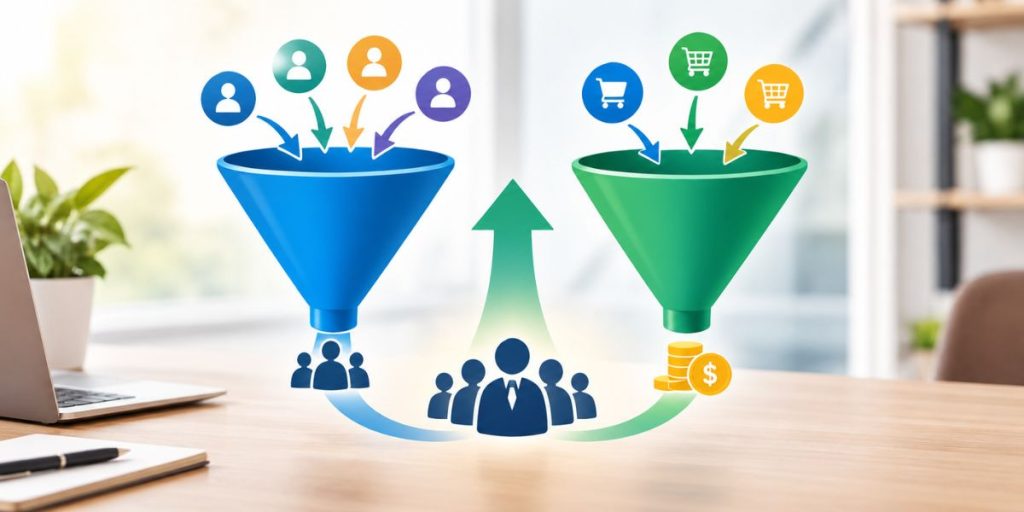
Most advice on business growth strategy assumes growth comes down to one question: how do we get more customers? For home care agencies, delivery service providers, cleaning companies, staffing firms and other labor-based businesses, that's only half the problem. Every new client needs a caregiver, driver or technician to deliver the service. Win customers faster than you can hire, and you turn work away. Hire faster than you win customers, and you pay people to wait. This guide is for owners of service businesses whose revenue depends on staffing. It explains the two-funnel model, compares the customer and worker funnels side by side, and shows how to plan growth so the two stay balanced.
What Is a Two-Funnel Growth Strategy?
A two-funnel growth strategy is a plan that manages customer acquisition and worker recruitment as two connected funnels instead of separate projects. One funnel brings in clients or contracts. The other brings in the employees who deliver the service. Growth happens only when both funnels produce results at the same pace.
In most businesses, marketing and hiring sit in different places. Marketing belongs to the owner or an agency, and hiring belongs to an office manager or HR. They use different tools, different budgets and different reports. That works when staffing is easy to find. It breaks down when labor is the constraint.
The two-funnel model treats both as one growth system with shared questions:
- How many new customers can we serve next month with our current staff?
- How many new hires do we need to serve the customers we expect to win?
- Which funnel is the bottleneck right now?
- Where should the next dollar of budget go?
The answer changes from month to month, which is why the strategy needs regular measurement, not an annual plan that sits in a folder.
Why Do Some Businesses Need Two Funnels?
Businesses need two funnels when their revenue depends directly on the number of workers available to deliver the service. In home care, delivery, cleaning, staffing and field services, each new customer needs labor hours. If hiring can't keep up, customer growth stalls, whatever the marketing budget.
The labor data explains why hiring is a growth issue, not just an HR issue. According to the U.S. Bureau of Labor Statistics, employment of home health and personal care aides is projected to grow 18 percent from 2025 to 2035, with about 760,500 openings each year on average. The BLS projects about 152,700 openings a year for delivery truck drivers and driver/sales workers. In both occupations, the BLS notes that most openings come from replacing workers who leave, which means businesses have to keep hiring just to stay the same size.
Competition for those workers is steady. The BLS JOLTS report released September 1, 2026 counted 7.3 million job openings and 3.1 million quits in July 2026. Workers in these roles have options, and employers who respond slowly lose them.
Marketing budgets rarely stretch to cover both needs. Gartner's 2025 CMO Spend Survey of 402 marketing leaders found that budgets held flat at 7.7 percent of company revenue, and 59 percent of CMOs said they didn't have enough budget to execute their strategy. For a small service business, the question is often which funnel gets the money this month, and without a plan, that decision gets made by whoever complains loudest.
How Do the Customer Funnel and the Worker Funnel Compare?
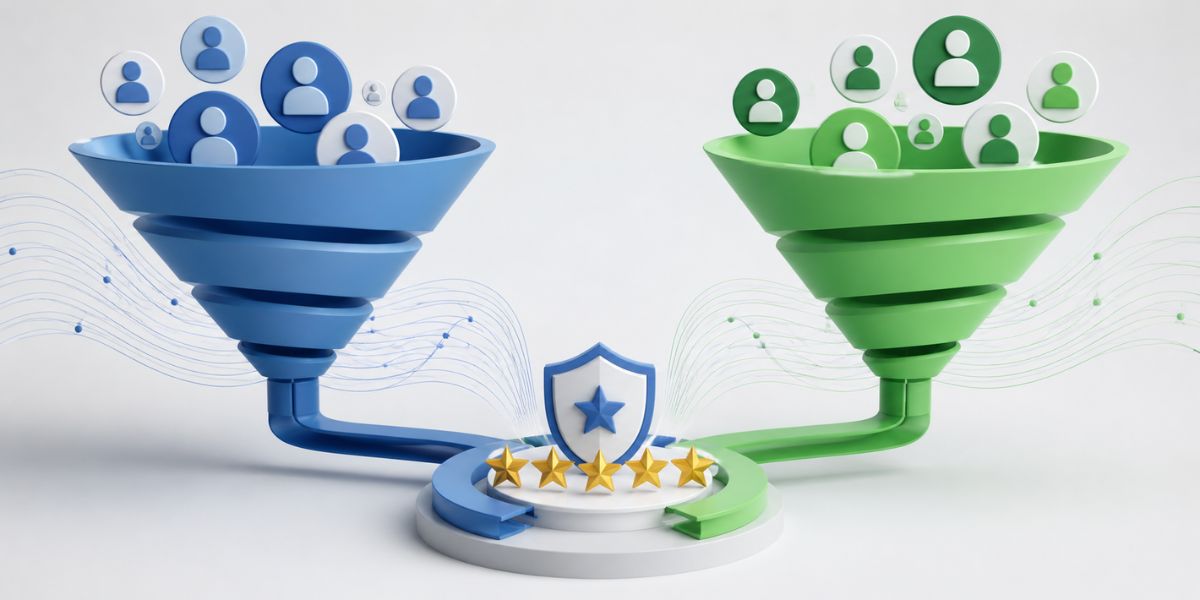
The customer funnel and the worker funnel follow the same stages: attract, capture, respond, qualify, convert and retain. The audiences, channels and metrics differ. Customers are won through search, reviews and referrals. Workers are won through job ads, fast text follow-up and a smooth hiring process. Both depend heavily on how quickly the business responds.
Here's how the two compare for a typical service business:
| Funnel stage | Customer funnel | Worker funnel |
| Attract | Local SEO, Google Business Profile, paid search, referral partners | Job boards, social ads, referrals, rehiring past applicants |
| Capture | Website forms, phone calls, inquiry tracking | Mobile applications, qualifying landing pages |
| Respond | Fast callback from the office or intake team | Instant text with a next step |
| Qualify | Service fit, location, budget or payer type | Licenses, certifications, availability, service area |
| Convert | Consultation or assessment, then signed agreement | Interview, background check, offer |
| Retain | Service quality, communication, reviews | Onboarding, scheduling, pay, support |
| Key metrics | Cost per lead, inquiry-to-client rate, client lifetime value | Cost per hire, show rate, time-to-hire, 90-day retention |
| Shared dependency | Reputation, response speed, reporting | Reputation, response speed, reporting |
The bottom row matters most. Both funnels rely on the same reputation, the same need for fast response and the same need for clear reporting. A Google profile full of unanswered complaints hurts client inquiries and job applications at once. That's why reputation management often pays off twice for labor-based businesses.
Tracking discipline pays off across the business too. Activated Insights' 2026 Home Care Benchmarking Report found that agencies tracking every client inquiry reported median revenue of $3.15 million, compared with $1.40 million for agencies that don't. The finding doesn't prove that tracking alone causes higher revenue, but it shows that agencies with measurement systems tend to run stronger operations. The same habit applies to the worker funnel.
What Happens When the Two Funnels Fall Out of Balance?
When the funnels fall out of balance, the business either turns away customers it can't staff or pays for workers it can't keep busy. Both waste money. Demand without capacity damages reputation and referral relationships. Capacity without demand raises labor costs and pushes new hires to quit. A balanced strategy adjusts spending before either problem grows.
More demand than capacity: A home care agency runs a strong local SEO campaign and gets a wave of new client inquiries. But it doesn't have enough caregivers, so it declines cases or delays start dates. Families go elsewhere, and hospital discharge planners stop sending referrals because the agency can't take patients quickly. The marketing worked, but the business couldn't use it.
More capacity than demand: A DSP hires aggressively before peak season, then volume comes in lower than expected. New drivers get fewer hours, frustration grows, and many leave. The station has paid to recruit, screen and onboard people who didn't stay.
Both funnels leaking: This is the most common situation. Client inquiries go unanswered for a day, applicants wait three days for a callback, and nobody has a clear view of either. Growth stalls without an obvious cause.
In each case, the fix isn't just spending more. It's knowing which funnel is the constraint and adjusting before the imbalance gets expensive.
How Do You Build a Two-Funnel Business Growth Strategy?
Build a two-funnel business growth strategy by measuring your current capacity, setting linked targets for customers and hires, tracking both funnels in one place, setting budget rules based on the current bottleneck, and reviewing both weekly. The goal is a system where customer growth and hiring move together instead of reacting to each other.
A practical five-step approach:
- Calculate capacity: Figure out how many customers, hours or routes your current workforce can handle, and how many workers each new customer requires. For a home care agency, that might be caregiver hours per client per week. For a DSP, it's drivers per route plus a buffer for call-offs.
- Set linked targets: If the goal is 20 new clients this quarter, work out how many hires that requires, then factor in your normal turnover. The hiring target comes from the customer target, not from a separate guess.
- Track both funnels in one view: Leads, conversion rates, applicants, interviews and hires should sit side by side. Lead management software that handles both customer inquiries and applicants makes this far easier than juggling separate spreadsheets.
- Set budget rules: Decide in advance how spend shifts when one funnel falls behind. For example, if open shifts go above a set level, move budget from client ads to recruitment marketing until staffing catches up.
- Review weekly: Look at both funnels together each week. Monthly reviews are usually too slow in high-turnover businesses.
Industry details shape each step. For home care, see how the model applies on our home care marketing and recruiting page. Delivery providers face a seasonal version of the same problem, where peak volume drives both route demand and driver hiring.
Where Does Business Strategy Consulting Fit?
Business strategy consulting fits when an owner doesn't have the time, data or outside perspective to manage both funnels. A strategy consultant or fractional marketing leader can set up capacity planning, connect reporting across marketing and hiring, and make budget decisions based on the current bottleneck instead of habit.
Many small businesses have capable vendors for each piece, such as an SEO agency, a job-ad freelancer or an office manager handling applicants, but nobody connects them. The main value of outside strategy help is that coordination: one person who sees both funnels, owns the targets and decides where money goes next.
Common mistakes a good consultant helps avoid:
- Treating hiring as a cost center: In labor-based businesses, recruiting is part of growth, not overhead.
- Measuring the wrong things: Website traffic and applicant counts look good in reports but don't show whether customers are being served or hires are staying.
- Running separate tools and reports: When customer and worker data live in different systems, imbalances show up late.
- Planning once a year: Labor markets and demand shift monthly, and so should the plan.
A two-funnel approach has limits as well. It depends on reasonably accurate data, and small businesses often start with gaps. It also can't make up for pay that trails competitors or service quality that drives clients away. The model shows where the problem is, but fixing it still takes action.
Wyred Insights built its Director of Results service around this model, pairing fractional marketing leadership with dashboards that track client and applicant funnels for businesses such as home care agencies and delivery service providers.