
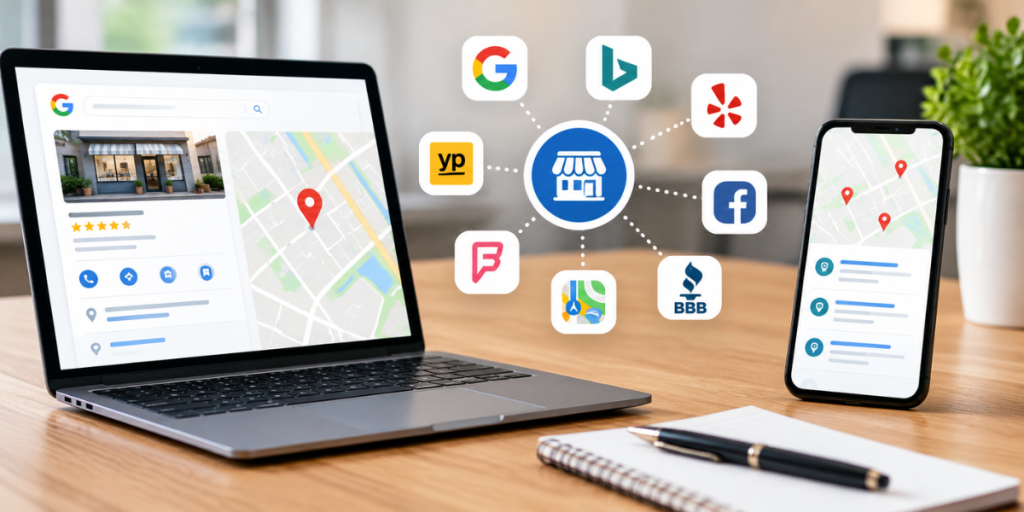
If you’ve been quoted for citation building services lately, you may have wondered whether listing your business on 80 directories still does anything. It’s a fair question. A decade ago, citations were one of the main levers for local rankings. Today Google leans far more on your Business Profile, reviews and website. But AI search has given business listings a second life, because ChatGPT and Google’s AI answers pull heavily from directory data. This guide explains where citations stand in 2026, which ones still matter for service businesses, and how to spend your time and budget on them wisely.
Do Local Citations Still Matter for SEO in 2026?
Yes, but differently. Local citations, which are online mentions of your business name, address and phone number, carry less direct weight in Google Maps rankings than they did ten years ago. They now matter more for data accuracy, trust and AI search visibility, where tools like ChatGPT and Google AI Overviews rely on listing data to describe businesses.
Whitespark’s Local Search Ranking Factors 2026 report shows both sides of this. Citation signals lost about half a percentage point of weight in the local pack this year, continuing a decline that has run for roughly a decade. Yet the same survey found that three of the top five factors for AI search visibility are citation factors.
Whitespark founder Darren Shaw goes further, arguing that in AI search, mentions are starting to play the role links play in traditional SEO. That’s an expert opinion rather than a confirmed Google statement, but it matches what recent studies of AI answers are showing.

What Counts as a Local Citation?
A local citation is any online mention of your business name, address and phone number, often shortened to NAP. Structured citations appear on business directories and map platforms such as Yelp, Apple Maps and Bing Places. Unstructured citations appear in local news stories, blog posts, chamber of commerce pages and industry association websites.
Not every citation carries the same value. The table below groups them by type and shows where each one earns its place today.
| Citation type | Examples | Main value in 2026 |
| Primary map platforms | Google Business Profile, Apple Business Connect, Bing Places | Accurate map data, rankings and AI visibility |
| Major directories | Yelp, Better Business Bureau, Yellowpages, Facebook | Trust, review visibility and frequent AI sources |
| Industry directories | Angi, Avvo, Healthgrades, Caring.com | Relevance for a specific trade or vertical |
| Data aggregators | Data Axle, Foursquare, Localeze | Feed accurate details to hundreds of smaller sites |
| Unstructured mentions | Local news, blogs, associations, sponsorships | Prominence and brand authority |
Unstructured mentions often get overlooked because they can’t be bought in bulk. A feature in a local paper or a listing on a trade association site also supports wider brand visibility, which helps with both customers and search engines.
Why Are Citations Becoming Important Again for AI Search?
AI search tools need trustworthy sources before they recommend a local business, and business listings are among the sources they cite most often. When ChatGPT, Google AI Mode or AI Overviews answer “best plumber near me,” they frequently draw on Google Business Profile, Yelp and niche directories. Missing or inconsistent listings reduce your chances of being named.
BrightLocal’s 2026 study of local AI search analyzed nearly two million citations across ChatGPT, Google AI Overviews and Google AI Mode for more than 1,300 business locations. Google Business Profile was cited for 94% of the businesses studied and Yelp for about 85%. Yelp appeared in 80% of ChatGPT’s local answers, making it ChatGPT’s most common local source.
Vertical matters too. An earlier BrightLocal study of ChatGPT search, run in late 2024, found directories made up 62% of the sources for “best electrician” searches, far above the average. If your trade has strong niche directories, those listings may influence AI recommendations more than your own website does.
What Does Good Local Citation Management Look Like?
Good local citation management means keeping your business name, address, phone, hours, categories and website identical on every platform that matters, then checking them on a schedule. It’s ongoing maintenance rather than a one-time project, because directories pull outdated data from aggregators, users suggest edits, and businesses move, rebrand or change phone numbers.
Whitespark’s 2026 survey supports the focus on accuracy over volume. The highest-ranked citation factor for the local pack was consistency on the primary search engines: Google Maps, Bing Maps and Apple Maps. Factors based purely on citation quantity ranked much lower.
The most common problems are easy to miss: duplicate listings left behind after an office move, old call-tracking numbers, suite numbers formatted differently, and wrong categories on data aggregators. A practical process starts with your Google Business Profile, then fixes Apple and Bing, then submits clean data to the aggregators, then claims major and industry directories. After that, a quarterly check catches drift. Treating local citation management as one part of your wider local SEO process keeps it from becoming a forgotten side task.
Claiming listings also means watching the reviews on them. Yelp and industry directories collect reviews that AI tools read, so they belong inside your reputation management routine as well.
Are Citation Building Services Worth Paying For?
Citation building services are worth paying for when they focus on accuracy and relevance: cleaning up duplicates, fixing the core map platforms and listing you on the directories your customers and AI tools actually use. They’re rarely worth it when sold as a bulk package of hundreds of low-quality listings with no ongoing management or reporting.
Before hiring anyone, ask a few direct questions. Which specific sites will you submit to, and why those? Will you find and fix existing errors and duplicates, or only add new listings? Who owns the logins once the work is done? How will you monitor listings after launch? A provider who can’t answer clearly is probably selling volume.
At Wyred Insights, we treat citation building services as part of local SEO rather than a standalone package, because clean listings only pay off when the Business Profile, website and review flow are working too.
Citations won’t carry your rankings on their own anymore. What they do is make sure Google, AI tools and customers all see the same accurate facts about your business. Audit your top ten listings this month and fix anything that doesn’t match your Business Profile exactly.