
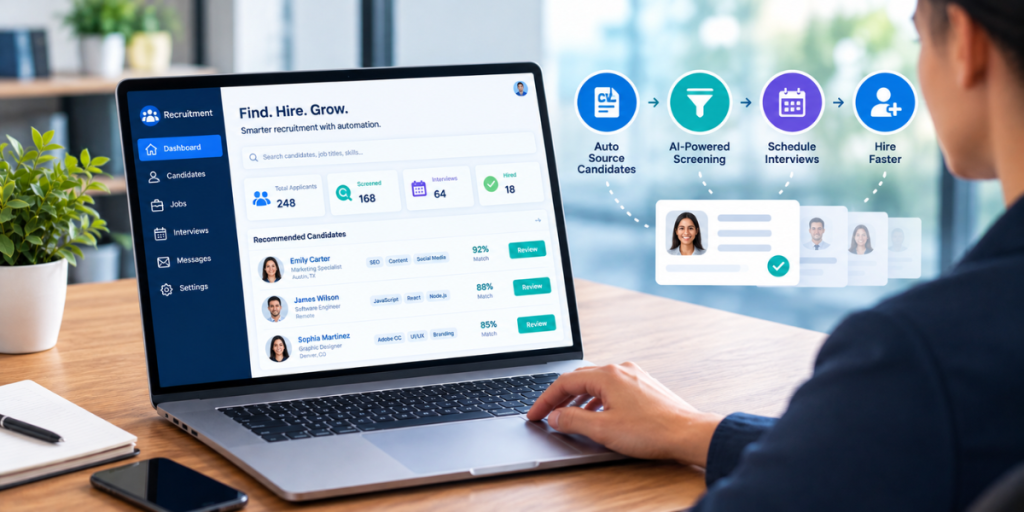
Recruitment automation software and a new recruiter both promise the same thing: faster hiring when applications pile up faster than your team can call them back. One adds a person. The other takes the repetitive work off the people you already have. For home care agencies, delivery service providers and other high-volume employers, the choice comes down to cost, capacity and what’s actually slowing hiring down. This guide breaks down the fully loaded cost of a new recruiter, what automation replaces and what it can’t, and how to decide which investment pays back faster for your team.
How Much Does Hiring Another Recruiter Really Cost?
A new in-house recruiter costs far more than salary. Using federal data, a recruiter at the median wage for human resources specialists earns about $72,910 a year, and benefits push the fully loaded cost to roughly $106,000. Add recruiting fees, onboarding time, equipment and the months before they’re fully productive.
Here’s the math. The Bureau of Labor Statistics reports that the median annual wage for human resources specialists, the occupation group that includes recruitment specialists, was $72,910 in May 2024. Wages are only part of the bill. BLS data for June 2026 show that for full-time private industry workers, wages made up 68.5% of employer compensation costs, with benefits accounting for the remaining 31.5%. Dividing $72,910 by 0.685 puts total compensation at roughly $106,400 a year. That’s an estimate, and local pay varies, but it’s a fair starting point.
Then come the costs that never show up on payroll: the cost of hiring the recruiter, time spent training them on your process, a laptop and software seats, and a ramp-up period before they’re working at full speed. A recruiter also doesn’t remove your job board or ad spend. They still need applicants to work with.
And one person has a ceiling. Forty hours a week, business hours only, minus vacation and sick days. If volume doubles during a hiring surge, you’re back where you started.
What Does Recruitment Automation Software Actually Replace?
Recruitment automation software replaces the repetitive, time-sensitive tasks that eat a recruiter’s day: posting jobs to multiple boards, texting applicants back, asking screening questions, scheduling interviews, sending reminders and following up with no-shows. It doesn’t replace interviewing judgment, relationship building or the final hiring decision, which still need a person.
Consider a simple example. Say an agency receives 200 caregiver applications a month. If a coordinator spends 10 minutes per applicant on first contact and screening, and another 10 minutes trading messages to book an interview, that’s about 67 hours a month before a single interview takes place. Recruitment automation software can cover most of that: an instant text when someone applies, a short qualifying questionnaire, and a self-booking link that puts qualified applicants straight onto the calendar. Automated interview scheduling alone removes the back-and-forth that turns a same-day interview into a next-week one.
It also keeps working outside business hours, when no recruiter is available to respond. Most platforms pair automation with applicant tracking software, so every applicant’s source, status and message history sits in one record. That’s what lets you measure cost per hire by channel instead of guessing.
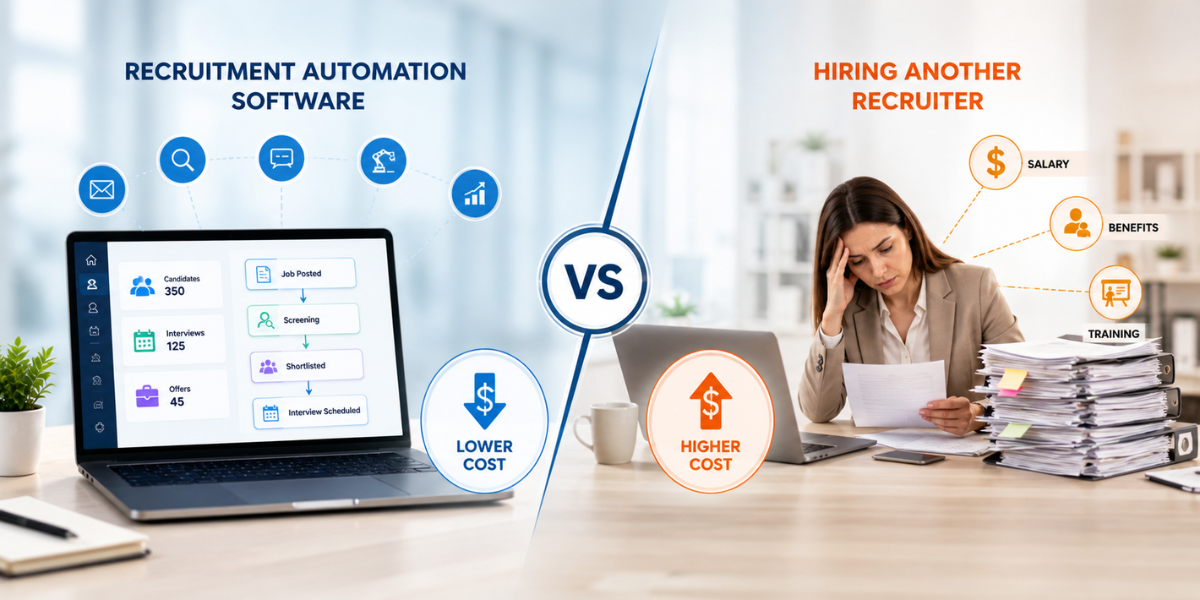
Recruitment Automation Software vs a New Recruiter: Side-by-Side
On cost, automation usually wins, because a subscription scales with volume instead of adding a six-figure cost line. On judgment and relationships, a recruiter wins. For high-volume hourly hiring, most of what slows hiring down is repetitive follow-up, which is exactly the work automation handles best.
| New in-house recruiter | Recruitment automation software | |
| Annual cost | About $106,000 fully loaded at the median HR specialist wage (estimate) | Subscription that varies by vendor and volume; get quotes |
| Availability | Business hours, minus vacation and sick days | 24/7, including nights and weekends |
| Response time | Depends on workload and time of day | Seconds after an application arrives |
| Capacity | Fixed; hiring surges create backlogs | Scales with applicant volume |
| Time to value | Weeks to hire, then a ramp-up period | Days to weeks to configure workflows |
| Best at | Interviews, judgment, relationships, hard-to-fill roles | Screening, scheduling, reminders, follow-up, reporting |
| Main risk | Turnover in the recruiter role itself | Poor setup or generic, robotic messaging |
The last row deserves attention. Automation set up badly can make hiring worse, with messages that feel cold or irrelevant. The software only saves money if the workflows match how your applicants actually behave.
When Does Hiring a Recruiter Still Make Sense?
A recruiter is the better investment when roles are specialized or senior, hiring volume is low but each hire is high-stakes, community-building and referral partnerships are priorities, or your team already has automation in place and the main bottleneck is interview capacity rather than follow-up.
A director of nursing or an operations manager for a delivery station is a different search from filling 15 caregiver or driver shifts. Those hires depend on networking, persuasion and judgment that software doesn’t provide.
There’s also a middle path. Some employers don’t want to build workflows themselves or add headcount, so they use a managed digital recruiting service, where specialists run the automation, ad campaigns and applicant pipeline on the employer’s behalf. That option costs more than software alone but typically far less than a full-time hire.
How Do You Decide Which Costs Less for Your Business?
Compare the fully loaded cost of a recruiter with the annual cost of software, then look at where time actually goes. If most recruiter hours are spent on first contact, screening and scheduling, automate first. If hours go to interviews and closing candidates, add a person. Often, automation delays or removes the need for another hire.
A practical way to run the comparison:
- Track one week of your current recruiter or coordinator’s time by task.
- Count monthly applicants and measure how long each waits for a first reply.
- Get software quotes and compare the annual total with the roughly $106,000 benchmark, adjusted for your local wages.
For home care agencies in particular, volume isn’t going away. BLS projects about 765,800 openings for home health and personal care aides each year, on average, over the 2024 to 2034 decade. Adding a recruiter for every jump in demand doesn’t scale well. Automation does.
The Wyred Insights platform was built for this kind of hiring, combining recruitment automation and applicant tracking with the same lead management tools used for client marketing, so a lean team can run both pipelines from one dashboard.