
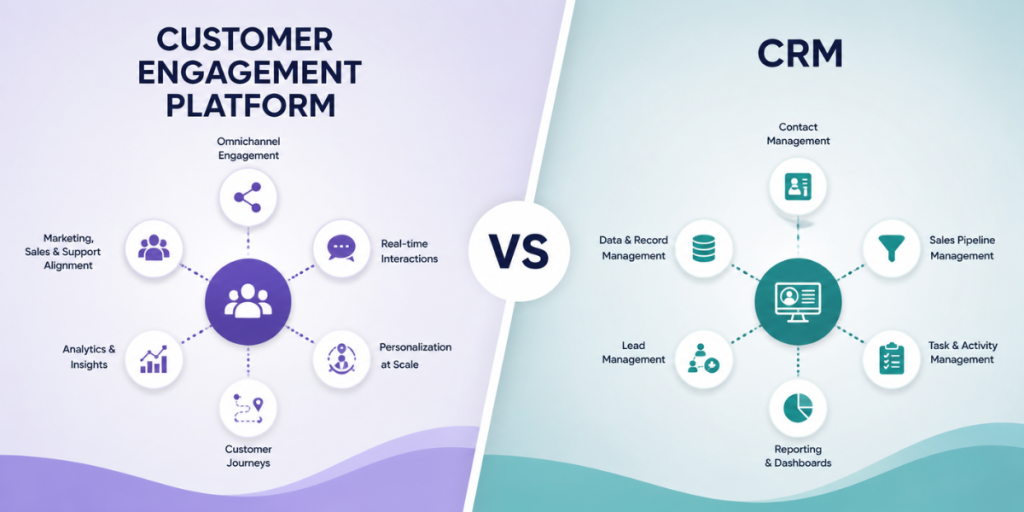
A customer engagement platform promises to keep every customer conversation moving: texts, emails, calls, reminders and review requests, each triggered at the right moment. A CRM promises to keep every customer record organized. For a growing service business, such as a home care agency or a delivery service provider, the two can sound interchangeable, and vendors don’t help by using both labels for the same product. The real difference is what each tool is built to do. This guide explains what a customer engagement platform is, how it differs from a CRM, where a marketing automation platform fits, and how to decide what your business needs next.
What Is a Customer Engagement Platform?
A customer engagement platform is software that manages two-way communication with leads and customers across channels like SMS, email, phone, voicemail and chat. It triggers messages based on what a person does, keeps conversations in one inbox, and handles moments such as appointment reminders, follow-ups and review requests in real time.
Picture a family member submitting a care inquiry at 9 p.m. A customer engagement platform texts back within seconds, asks one qualifying question and sends a booking link. Once she schedules an assessment, it sends a reminder the day before and the morning of. If she misses the appointment, a reschedule text goes out automatically. After care starts, it checks in on satisfaction and, at the right point, asks for a review. A CRM would record that all of this happened. The engagement platform is what makes it happen.
That gap between what businesses think they deliver and what customers feel is well documented. For its 2025 State of Customer Engagement Report, Twilio surveyed 7,640 consumers and 637 business leaders and found that 82% of leaders believed they deeply understood their customers, while only 45% of consumers agreed. In a service business, that gap usually shows up in the small moments: a slow reply, a generic message, a reminder that never went out.

What Does a CRM Do That an Engagement Platform Doesn’t?
A CRM is the system of record. It stores contacts, companies, deals and their full history, organizes them into pipelines, and reports on what happened. A CRM tells you who a customer is and where they stand; an engagement platform decides what to say to them next and on which channel.
CRMs are built for structure: pipeline stages, ownership, tasks, deal values and forecasting. They’re how a manager sees that 14 assessments are booked this week and which coordinator owns each one.
The weakness of many traditional CRMs is that communication happens somewhere else. A coordinator texts from a personal phone or sends an email from Gmail, then logs it later, if at all. Follow-up depends on someone remembering. Salesforce’s tenth State of Marketing report, based on nearly 4,500 marketers, found that 69% still struggle to respond to customers promptly and 84% admit to running generic campaigns. A well-organized database alone doesn’t fix either problem.
Customer Engagement Platform vs CRM: Side-by-Side Comparison
A CRM organizes customer data and pipelines; a customer engagement platform acts on that data through timely, two-way messages. The CRM answers “who is this and where do they stand,” while the engagement platform answers “what should happen next.” Most growing service businesses need both capabilities, and the best results come when they share one database.
| CRM | Customer engagement platform | |
| Core role | System of record | System of action |
| Main question | Who is this, and where do they stand? | What should we say next, and on which channel? |
| Key features | Contact records, pipelines, tasks, deal tracking, reporting | Two-way SMS and email, automated sequences, scheduling and reminders, voicemail drops, review requests |
| Timing | Updated as work happens, often manually | Triggered in real time by customer actions |
| Typical owner | Sales or operations | Marketing, intake or customer success |
| Success metrics | Pipeline value, win rate, forecast accuracy | Response time, reply rate, show rate, review volume |
| Risk when used alone | Accurate records, slow follow-up | Fast messages with no context or reporting |
The last row matters most. Each tool on its own fails in a predictable way, which is why the decision is rarely “one or the other.”
Where Does a Marketing Automation Platform Fit?
A marketing automation platform handles one-to-many campaigns: email newsletters, nurture sequences, audience segments and remarketing. It overlaps with a customer engagement platform but is usually one-way and campaign-driven, while engagement platforms focus on one-to-one, two-way conversations. Many modern tools blend both, so judge features, not labels.
A monthly email to past clients about respite care is a job for a marketing automation platform. A text exchange with a daughter rescheduling her father’s assessment is an engagement job. Service businesses tend to lean harder on the second, because revenue is won or lost in individual conversations, and channel choice matters: in high-turnover hiring, for example, SMS tends to outperform email for speed and response.
Getting this layer wrong is expensive. Twilio’s 2025 report also found that 71% of consumers abandon purchases when the experience falls flat. Campaign automation keeps you top of mind. Engagement is what keeps a warm lead from going cold.
Which Does a Growing Service Business Need?
Most growing service businesses should start with a CRM that has customer engagement built in, rather than buying separate tools. If your records are organized but follow-up is slow or inconsistent, add engagement capabilities first. If messages go out quickly but nobody can report on results, strengthen the CRM and reporting side.
Signs the engagement side is the gap:
- Leads wait hours for a first reply, especially after hours and on weekends.
- No-shows are common and nobody sends reminders consistently.
- Staff text customers from personal phones, so conversations are invisible to the team.
- Reviews arrive by chance rather than through a routine ask.
If instead you can’t see your pipeline, don’t know where leads come from, or keep finding duplicate contacts, the CRM side needs work first.
Buying two separate systems can work, but test the connection before you commit. Message history should write back to the contact record, automations should trigger from pipeline changes, and reporting should tie conversations to outcomes. Without that, you get fast messages and a CRM that tells only half the story.
This matters even more for businesses that talk to clients and job applicants every day, like home care agencies and delivery service providers. The Wyred Insights platform was built for that combination: CRM pipelines and a unified contact history alongside engagement tools such as two-way SMS and email, self-scheduling, automated reminders and ringless voicemail, used for client prospecting and recruiting alike. The same record supports post-sale follow-up and structured reputation management, so engagement doesn’t stop once the first service is booked.
ment tools avoids sync problems and duplicate data.
Frequently Asked Questions